Showing posts with label Influence. Show all posts

Friday, November 14, 2025

Christianity and Culture: Are We Seeing Clearly?


In a podcast many years ago, historian Tom Woods made an interesting observation. He said something like this: “We often talk about how Christianity has shaped America, but we should also consider how America has shaped Christianity.”


That idea has stuck with me. It raises a challenging question: Could it be that we often fail to hear Jesus clearly because we filter His words through the lens of our own culture?


We are all shaped by the time and place we live in. Culture shapes what feels natural, what seems right, and what we consider normal. This is not always bad—culture gives us traditions, community, and stability. But culture can also blind us. It can lead us to accept certain practices and attitudes without ever questioning if they truly align with God’s will.


A Biblical Example of Cultural Compromise

Genesis 16 gives us a powerful example of this reality. In that passage, Sarah convinces Abraham to father a child by using her servant Hagar. In their culture, this was a perfectly acceptable practice to secure an heir. It was a solution that fit the customs of their world.


While it was an acceptable practice, it was not the way of faith. God had promised Abraham and Sarah a child, but instead of waiting for God to fulfill His word, they settled for a culturally approved shortcut.


From our perspective in 21st century United States, it is easy to look back and see their error. But in their moment, Abraham and Sarah were doing something that made sense to them. They weren’t trying to rebel against God; they were trying to solve a problem within the framework their culture gave them.


How often do we do the same?


The Subtle Power of Culture

The danger of cultural compromise is that it rarely feels like compromise. It feels natural. It feels responsible. It feels like common sense. That’s why it is so easy for us to use cultural assumptions in our interpretations of biblical truth.


For Christians living in the United States, this challenge is especially subtle. American values—like individualism, consumerism, and the pursuit of success—are so deeply ingrained in us that we may not realize when they conflict with the way of Jesus.


For example:

  • Do we measure a church’s faithfulness by its size and influence (an American metric), or by its obedience to Jesus’ commands (a kingdom metric)?
  • Do we prioritize personal freedom over self-giving love, even though Jesus taught that true freedom is found in serving others?
  • Do we accept violence, power, and dominance as necessary evils, forgetting that Jesus called us to love our enemies and pray for those who persecute us?

None of these cultural values are neutral. They shape the way we hear Scripture, the way we structure our churches, and the way we live our faith.


Following Jesus, Not an Americanized Christianity

The task before us, then, is to make sure we are truly following Jesus—not just an Americanized version of Christianity that baptizes our cultural assumptions with our cherry picked Bible passages. That requires humility. It requires discernment. And it requires a willingness to question the things we have been taught as “biblical” but may not actually come from Scripture.


Abraham and Sarah remind us how easy it is to be led by what feels normal instead of what God has promised. The same danger confronts us today. Will we trust Jesus enough to follow His way, even when it goes against the flow of our culture?


A Call to Self-Examination

Perhaps one of the most important spiritual disciplines we can practice is self-examination in light of Scripture. We need to ask:

  • Am I believing this because it is biblical, or because it is cultural? 
  • Does my discipleship reflect the values of the kingdom of God or the values of America? 
  • Where might I be settling for what feels natural rather than waiting on the promises of God?

These are not easy questions. But they are necessary if we want to live faithfully as disciples of King Jesus.


The good news is that God is patient with us, just as He was patient with Abraham and Sarah. He invites us to step out of cultural conformity and into the radical life of faith, trusting that His way is better than anything our world has to offer.


Reflection

Take a moment to sit with this question: How has my faith been shaped more by culture than by Christ?


Ask the Holy Spirit to reveal blind spots where cultural assumptions have crowded out biblical truth. Then pray for the courage to follow Jesus even when it feels strange, unpopular, or countercultural.


“Lord Jesus, help me to see where I have settled for a comfortable, cultural version of faith instead of the radical way of Your kingdom. Give me eyes to see clearly, ears to hear Your voice, and a heart willing to obey—even when it goes against what feels normal. Teach me to live as Your disciple first and foremost. Amen.”


Paul’s Ponderings is a blog dedicated to reflecting on Scripture and encouraging believers to live out their faith with love and purpose.

Friday, July 4, 2025

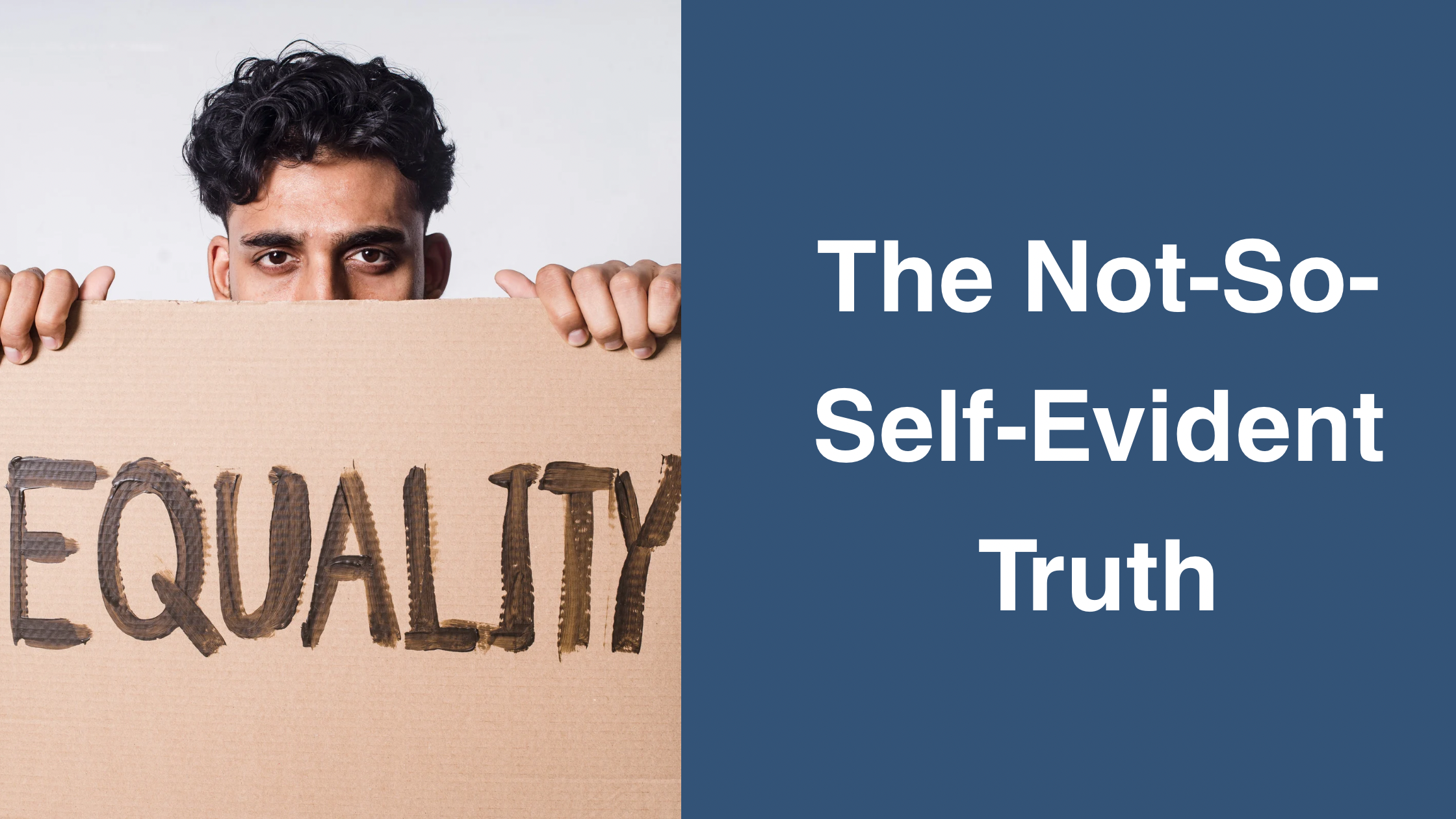
The Not-So-Self-Evident Truth


When Thomas Jefferson penned the words, “We hold these truths to be self-evident, that all men are created equal, that they are endowed by their Creator with certain unalienable Rights, that among these are Life, Liberty and the pursuit of Happiness,” he framed a vision that would define the United States. These words from the Declaration of Independence are among the most iconic in American history, often quoted as the bedrock of our nation’s values. But how “self-evident” is the idea that all people are created equal? A closer look at nature, history, and the cultural context of the Founding Generation suggests that this truth is far from obvious—and its origins may lie in a source many overlook: the Christian faith.

Nature’s Inequality vs. the Idea of Equality

If we observe the natural world, the notion of equality doesn’t leap out at us. In fact, nature often highlights inequality. Humans vary widely in physical attributes—height, strength, beauty—and in intellectual capacities, talents, and abilities. Some are born with exceptional gifts, while others face significant challenges from birth. If anything, nature seems to emphasize differences, not sameness. So where did Jefferson and the Founding Generation get the idea that all people are created equal?

The answer lies not in the observable world but in the philosophical and spiritual framework that shaped their thinking. For the Founders, the concept of equality wasn’t derived from empirical observation but from a deeper belief: that every individual is endowed with inherent worth by their Creator. This idea, revolutionary in its implications, didn’t emerge in a vacuum. It was deeply rooted in the Christian worldview that permeated the culture of 18th-century America.

The Christian Foundation of Equality

The New Testament, in particular, provides a theological basis for the equality of all people. One striking example is Colossians 3:11 (CSB), which states, “In Christ there is not Greek and Jew, circumcision and uncircumcision, barbarian, Scythian, slave and free; but Christ is all and in all.” 

This passage, along with similar teachings throughout the New Testament, emphasizes the inherent dignity and worth of every individual, regardless of social status, ethnicity, or background. In a world divided by class, race, and power, these words were radical. They laid the groundwork for the belief that every person is equal in the eyes of God—a belief that would eventually shape the moral and political ideals of the Founding Generation.

This Christian influence is evident in the Declaration’s assertion that rights come from a Creator, not from human institutions or natural hierarchies. The idea that every person possesses “unalienable Rights” to life, liberty, and the pursuit of happiness reflects a worldview where human value is grounded in divine creation, not in worldly status or ability. While the Founders drew on Enlightenment thinkers like John Locke, the concept of equality they embraced was filtered through a distinctly Christian lens, one that saw every soul as equally precious in God’s sight.

The Imperfect Application of a Revolutionary Idea

Of course, the Founding Generation’s commitment to equality was far from perfect. The same men who proclaimed that “all men are created equal” lived in a society that tolerated slavery, restricted voting rights, and marginalized entire groups based on race. This glaring contradiction between principle and practice is a stain on their legacy. Yet, it’s worth noting that the ideals they articulated laid a foundation for future generations to challenge these injustices. The Declaration’s words became a rallying cry for abolitionists, suffragists, and civil rights activists who sought to hold America accountable to its own stated values.

The imperfections of the Founders don’t negate the significance of their contribution. By declaring the idea of equality as a God-given truth, they planted a seed that would grow over time, inspiring movements to expand liberty and justice to all. The Christian belief in the equal worth of every individual, rooted in scriptures like Colossians 3:11, provided a moral framework that made such progress possible.

Why This Matters Today

In our modern world, the idea that all people are created equal is often taken for granted, as if it’s a universal truth that everyone naturally accepts. But history and nature tell a different story. Without a foundation like the one provided by the Christian worldview, the concept of equality might not have taken root in the way it did. As we navigate contemporary debates about justice, rights, and human dignity, it’s worth remembering the spiritual origins of these ideas. They remind us that equality is not just a political principle but a profound moral conviction—one that calls us to see every person as bearing the image of their Creator.

The words of Jefferson and the biblical teachings that inspired them continue to challenge us. They push us to bridge the gap between our ideals and our reality, to strive for a world where the equality of all is not just proclaimed but lived out. The Founding Generation may not have fully realized this vision, but they gave us the tools to build on their foundation. It’s up to us to keep constructing.

7 Habits to Help Beat the Winter Blues

As the days grow shorter and the sun seems to hide behind gray skies, many of us feel our energy dip and melancholy begin to creep in. The w...